
Tag: battery

  • “Practice what you preach” – why it can be difficult

    “♫Can you practice what you preach? Or would you turn the other cheek?♬”. These lines come from “Where Is The Love?”, a 2003 hit by The Black Eyed Peas. Other artists use the lines in different ways for their songs, too. For example, Madonna’s 1986 hit song, “Papa Don’t Preach”, contained this line in the chorus: “Papa don’t preach, I’m in trouble deep”! Okay, the songs themselves don’t actually relate to fixing, re-using and re-purposing computers. But the sentiments fit nonetheless!

    So, you may be asking us, “Why bring up the above songs, as well as the saying itself”? Well the thing is, we aim to do our bit in reducing the amount of e-waste we send to landfills. By fixing and renewing computers and other items, we keep them going for longer. We also suggest going for refurbished units as replacements for devices which are too old to keep running.

    But sometimes, even we struggle to practice what we preach ourselves – I raise my hand in admitting this here! I myself see – and buy – all kinds of brand new stuff in shops and online stores over the years. So why do we succumb to the temptation of buying new, instead of refurbished? How do we take the easy way out by replacing broken items, rather than fixing them? And why do manufacturers constantly lure us into doing so in the first place?

    What does “practice what you preach” mean?

    Basically, it refers to leading by example through behaving in the same way you expect others to behave. The idea originates from Asinaria, or “The Comedy of Asses”, by Roman playwright Titus Maccius Plautus. In the comedy play, Libanus had this to say upon replying to a remark about hugging one another while chatting:

    “Tastes differ about what’s pleasant, sir, let me tell you that. A fond pair like you find it pleasant to hug each other while you do your chatting; but, personally, I don’t care for this fellow’s hugs, and as for mine, he scorns ’em. So you go on and practise yourself what you preach to us.”

    Libanus – Act 3, Scene 3 English translation from Asinaria (The Comedy of Asses)

    Roughly two centuries on from then, the phrase appeared in Matthew 23 of the Bible. Here, Jesus comments about the religious leaders of His time, specifically the Scribes and Pharisees. Particularly, He says the following to the crowds and His disciples:

    “The teachers of the law and the Pharisees sit in Moses’ seat. So you must be careful to do everything they tell you. But do not do what they do, for they do not practice what they preach.”

    Matthew 23:2-3 from the Bible

    He refers to the hypocritical actions of these religious leaders. They tell others to follow their teachings, but they don’t do the same themselves! And so, Jesus warns his disciples against behaving in the same hypocritical manner. Over subsequent centuries, people came up with variations of the phrase to convey the same meaning.

    So what makes it so difficult?

    There are several facets which make it difficult, even for people who are most ardent in reducing waste in general. These factors come together to keep consumers constantly buying new things. Here, we describe the main factors, and how they hinder us as we practice what we preach…:

    Planned obsolescence

    Ah, planned obsolescence. The perennial roadblock which gets in the way of building a sustainable society. Manufacturers build whole business models around sales of new products and expensive repair services. As we previously covered, they use various approaches to hinder our efforts to repair our own items, and get us to buy new ones instead. Think sealed-in batteries in phones, which make replacing them difficult when they wear out – or become spicy pillows!

    Negative experiences with refurbished items

    Sometimes, one bad experience with a refurbished item is all it takes to put consumers off buying refurbished products altogether. In turn, this makes them perceive new items as “safer choices”, as they will get a pristine item which works out of the box. Examples of bad experiences (some of which can also apply to new items as well!) include:

    • Receiving a broken, faulty or DOA item. Sometimes, a broken, or faulty or dead device slips through quality control and into the hands of an unsuspecting buyer. This is especially annoying when they spend large sums of cash on a refurbished device.
    • Receiving an activation locked Apple device. Activation Lock is part of Apple’s Find My anti-theft services. It helps owners track and wipe their Apple device in the event of loss or theft. While this feature is very useful, other people can’t use the device, if the previous owner forgot to remove the Activation Lock first! As a consequence, for example, charity shops discard a large number of perfectly working Apple devices.
    • Receiving a device which the previous rightful owner reported as lost or stolen. Sadly, there are thieves and other bad actors in society who steal various electrical gadgets. And so, when you buy one of these devices, you may end up receiving a stolen item. Thankfully, you can check a device you have an interest in, to see if it is on a database of lost and stolen devices.
    • Receiving a different item to the one the customer originally ordered. Sometimes, when we order something online, we receive the wrong item instead. For example, this may happen due to the ordered item being out of stock, and the retailer or seller sending an equivalent alternative item instead.
    • Poor customer service from the seller and/or marketplace. Botched item repairs. Multiple trips to the same or different repair shop. Repairs which don’t last long before an item breaks again. Problems getting a refund on a faulty or DOA refurbished item. These issues may drive customers to take shortcuts through purchases of new items.

    Marketing

    Marketing is everywhere. Often, they take on the form of adverts. They pop up on billboards, newspapers and websites. You hear them during breaks on commercial radio stations. Retailers also drape their store fronts with fancy banners and pictures, promoting discounts on stuff. Social media personalities, such as YouTubers and TikTok influencers, commonly promote brands themselves directly, in return for goods and/or money. Whatever they do, they aim to achieve one goal – to get you to buy their brand new items.

    Consumer attitudes
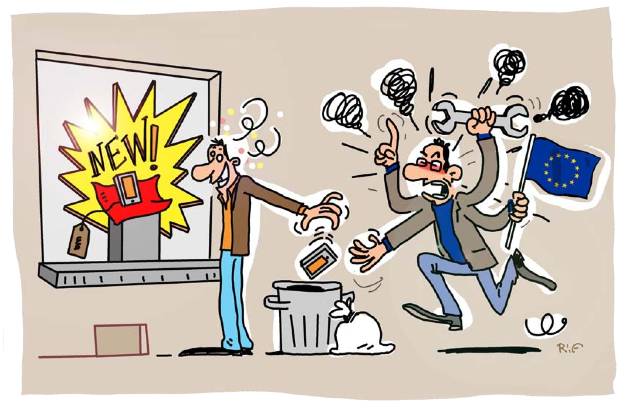
    A cartoon depicting a man dropping a mobile phone into a litter bin, while looking at a new phone displayed on the shop window. He ignores activists who practice what they preach about reducing e-waste, while holding an EU flag and a spanner. Image courtesy of EJOLT.
    A cartoon showing a man dropping his phone into a bin, while looking at a brand new phone. He completely ignores an activist who admonishes him for being wasteful with electronic gadgets.

    Unfortunately, some people in our society always default to buying new, however hard we try to convince them otherwise. They stubbornly refuse to even consider a refurbished device, let alone actually buy one. They perceive refurbished devices as “inferior” to a brand new model. Even a tiny scratch or scuff mark makes them run away and head for the nearest store selling new stuff. And what’s more, they even reject more sustainable and repairable devices such as Fairphones and Framework laptops. Plausibly because in their minds, specsheets and value for money are everything…

    And so, these attitudes are a shame, at a time when our planet is full of electronic waste. Because had they bought perfectly-working pre-owned gadgets instead, they can save them from going into recycling (or even worse – landfill!). And, by opting for more repairable devices, they can more easily keep them working for longer themselves!

    Frequent product refreshes

    Many manufacturers release new products on a regular basis. They often do so by making new models with iterative changes to specifications or designs. Or, they may rebrand an existing product and present it as a new product. This approach is particularly common among mobile phone and car brands, who release identical products for different markets under different names. Because of the regular product refreshes, we tend to buy things more often than we should.

    Lobbying

    Manufacturers often get behind various trade and lobby groups. These groups campaign against measures to make it easier for individuals and independent repair shops to repair various items. Campaigns against right to repair typically incorporate propaganda, (mis/dis)information, loaded language – and FUD! Lots and lots of FUD! (And no, we’re not referring to a certain part of the human anatomy, to our Scottish readers and fixers!)

    Actually, by FUD, we mean the shorthand for “fear, uncertainty and doubt”. It is a way of using negative emotions, such as fear and anxiety, to dissuade people and politicians from acting against manufacturers’ interests. These emotions hold people back from enacting measures to facilitate right to repair, and learning to fix items themselves. And ultimately, to push them towards expensive repair services offered by manufacturers themselves.

    An example of FUD would be OEMs using this image to exaggerate adverse consequences about letting users attempt to replace a sealed-in battery in a laptop or mobile device themselves.

    How do we practice what we preach, then?

    We can still practice what we preach by taking steps ourselves to reduce how much e-waste we produce. One main way we can achieve this, is to embrace our five R’s; renew, repair, reuse, remix and recycle. To summarise each of these:

    • Renew: Upgrading, resetting or refurbishing computers, mobile devices and other electronic devices.
    • Repair: Fixing devices by replacing broken parts and components with working ones.
    • Reuse: Salvaging working parts as they are from unfixable devices, in order to use them for repairs or upgrades.
    • Remix: Turning useful parts which no longer work for their original purpose into other useful things.
    • Recycle: Sending away unusable or completely obsolete items for recycling. This is the last resort for when we cannot find any suitable uses for parts or devices.

    Empowering people to fix their own devices is a great way to reduce e-waste. By learning how to replace worn, faulty or broken parts, they can save money on repairs and reduce the need to buy a whole new device. They can also use iFixit to find instructions on how to repair or replace parts for their device.

    But what if some people insist on buying new?

    As we previously mentioned, some people just don’t trust refurbished devices enough to buy these, instead of new ones. In this case, we offer an olive branch by sharing some tips to reduce purchases of new devices:

    • Maximise time between new purchases. The idea is to use new products for as long as possible from the date of purchase. By spreading out purchases of new devices, we can reduce the number of products manufacturers churn out of factories. And in turn, this helps reduce e-waste.
    • Choosing easy to repair devices. Ideal devices are products which you can take apart and repair easily with just a single screwdriver. By selectively buying easy-to-repair devices, you help show manufacturers why repairability is important in products. This also helps put pressure on them to make their products easy for users to repair.
    • Buying devices which you can turn into other useful things. If you can’t use something for its intended purpose anymore, you can still it for other things. By getting creative with how you use parts from broken or faulty equipment, you can help reduce the amount of e-waste.
    • Buying devices with readily available parts. Equally as important as easy repairability, is finding spare parts easily. Various parts manufacturers supply aftermarket parts for many popular mobile devices and laptops. So when your device breaks, you can buy just the part you need to fix it.

    Closing thoughts…

    All in all, yes there is always the strong temptation to go for the latest shiny new device coming out. But through repair and reuse, we can condition ourselves away from always buying new! And, we can practice what we preach to encourage others to do the same. Together, we can resist the allure of new and carry on using the devices we already have. So keep calm – and don’t let the OEMs scare you out of fixing your stuff!

  • Spicy pillows: what are they exactly?

    Ah, ‘spicy pillows’. It’s basically a term the techies among us use to describe how batteries which puff up overtime. Now, chances are you notice a battery in your tech gadgets which looks like it’s about to pop at any moment. In fact, there’s even a whole subreddit that showcases pictures of swollen batteries!

    An example of a spicy pillow. This spicy pillow was from a tablet
    A swollen battery from a tablet – courtesy of Reddit

    Batteries come in various shapes, sizes and chemical compositions. They power all kinds of everyday things that we take for granted. But we often associate spicy pillows with “pouch” lithium batteries. These are the ones that power laptops and mobile devices.

    Today, we’ll discuss what the term actually means, and how and why batteries can puff up overtime. We’ll also explain how you should safely handle a swollen battery.

    What are ‘spicy pillows’ anyway?

    Spicy pillows refer to the way lithium batteries in various mobile devices fail. These batteries are typically either lithium-ion (Li-ion), or lithium polymer (Li-Po) batteries. They rely on chemical reactions to produce energy for operating those devices.

    Sometimes, something goes wrong that causes the battery to enter ‘thermal runaway’. This is where a battery gets too hot, as it can’t cope with the excessive current flow and dissipation. In turn, the heat damages the layers in the battery, causing gases to form inside. The gases make the cell(s) gradually inflate until it looks like a pillow. Hence, the term ‘spicy pillow’.

    What causes batteries to become spicy pillows?

    There are three main reasons why batteries become swollen:

    1. Age: As batteries get older, chemical reactions are more likely to go wrong when the battery charges. When this happens, flammable gases form inside, damaging the separators between layers inside the battery. In the process, this makes the cell(s) of the battery expand.
    2. Physical damage: Manufacturers usually make the outer casing of batteries for mobile devices using thin materials. If we don’t install them correctly, or drop or hit them in anyway, we risk rupturing that casing. As a result, this exposes the chemicals in the battery to the air, causing it to inflate, ignite or explode.
    3. Manufacturing defects: Sometimes, little flaws develop in the making of batteries. These flaws make the layers inside the battery less likely to properly remain separate while in use. As a result, this makes them more likely to become swollen while charging.

    What makes spicy pillows dangerous?

    Swollen batteries present a fire hazard, in that they can catch fire without warning. Flammable gases can escape out of the casing, due to splits or cracks created by the excess pressure. Gases may also vent and catch fire if the battery has sustained a puncture.

    They are also an explosion hazard. Lithium is an alkali metal that violently reacts when exposed to air or liquid. That’s why we carefully store it in a vacuum, inert atmosphere, or in mineral oil or other inert liquids. Explosions can also happen due to bad product design. An infamous example of this happening is the Samsung Galaxy Note 7. Samsung recalled this smartphone from sale, after a small number of phones exploded. This was because the 3500mAh battery had no wiggle room in its recess, in case it became a spicy pillow.

    Fortunately, batteries have safety measures built-in to minimise the risk of fire or explosion. As long as you protect it from heat and physical damage, it’s unlikely to vent gas or catch fire. Thus, spicy pillows are not inherently dangerous as long as you take proper precautions.

    How do I know if I’ve got a spicy pillow?

    You can find out if your device has a swollen battery by looking at the device or the battery itself. There are three main ways you can do this:

    • Are any parts of your device out of alignment? Batteries exert pressure on neighbouring parts, pushing them aside as they swell up. You can see that this happens if there’s any gaps between parts of the case. It also happens with the displays on smartphones and tablets.
    • Is any gas escaping from the battery? Gases from the battery are especially poisonous, and inhaling them can damage your lungs. Therefore, never directly sniff or inhale deeply from near the battery! Instead, keep a safe distance and gently waft the area near the battery towards you. If there’s a sweet, metallic smell, then gas may be coming out of the swollen battery.
    • Does the battery itself look swollen? If you can easily access the battery without disturbing it, you can check the physical condition of it. Loose or wrinkled wrapping, a more rounded shape, or any lifting from its recess, are clear signs of a swollen battery.

    What should I do if I’ve got a spicy pillow?

    As soon as you notice a spicy pillow, don’t charge the battery in the device! Instead, disconnect it from the device if possible, put it into a fireproof container and take it outside. If your device has a sealed battery, try to discharge it as much as you can. Leaving your device turned on uses up power stored in the battery. This reduces the chances of a fire or explosion. You can back up any important data on the device to an external drive or microSD card while it discharges.

    If your laptop or smartphone has an easy to remove battery, then you can simply remove the battery from it. On older smartphones and some newer ones, you simply pull off the back cover and remove the battery. For batteries inside laptops, the base cover on most of them has screws. You can unfasten these with a Philips screwdriver. They connect to the motherboard with a short cable from the battery itself. You unplug the cable, the remove the screws holding the battery to the chassis.

    However, most smartphones and tablets have sealed batteries held in place with adhesive. If yours has a sealed battery, then we recommend taking the device to a repair shop. Technicians in repair shops typically have the necessary tools to safely remove swollen batteries. They will also help safely dispose or recycle them for you.

    What not to do with spicy pillows?

    First of all, never ever deliberately puncture a battery! Punctures can cause the battery to swell up, expel gas or catch fire. This video demonstrates how to safely handle swollen, dead or faulty batteries:

    This video, courtesy of iFixit, offers a useful and informative guide on how to safely handle batteries

    Also, you should never put swollen or defective batteries in household waste. That’s because they may damage the environment if they go into landfill! Instead, take them to your nearest recycling centre or in-store collection facility. Just in case, you can cover the contacts or connectors with some tape. This keeps them safe while you take them there. You can find out where your nearest recycling centre is here.

    Quickly summing up…

    For more information, iFixit has a useful guide on how to handle a swollen battery. It’s useful for those of you with suitable tools and who really know what you are doing. Spicy pillows are very unlikely to blow up on you as long as you handle them safely. So until next time, keep calm and keep on fixing – oh, and remember, no popping pillows!

  • The logical extremes of obsolescence

    Obsolescence is quite the nice little earner for OEMs everywhere. They love seeing ordinary folks like us pop into shops buying their latest stuff. Throwing away perfectly usable things we otherwise can use for other tasks. And when we point out the vast mountains of waste growing around the world, they shrug and say “so what?”

    And so, we don’t put it past them to take obsolescence to (logical) extremes. After all, giving them more ideas just makes the e-waste problem worse. But…here we are. So, here are just a few items we imagine the pesky OEMs baking obsolescence into them. Here’s hoping their reps don’t barge into our repair cafes and take notes…

    Stitching obsolescence into sewing machines

    Ah, sewing machines. Complex bits of machinery with spool holders for strings and physical controls. People make all kinds of clothes and fancy costumes with them. Over the years, they mostly withstood the scourge of planned obsolescence – or have they?

    Well, not if manufacturers have their way! Because, we imagine OEMs making sewing machines as one solid unit with everything inside! Spools full of threads of a certain colour, all the components, the controls, the works! So here, you need a smartphone app to control everything, and have the machine do all the sewing for you.

    But, what if you need a different colour thread for your project? Basically, just buy a new sewing machine containing the colour of the thread you want – duh! And what if it breaks down while it sews up your new garment? Buy a new one! Oh, and don’t even think of trying to repair it yourself, or take it to a repair centre other than the manufacturer’s! You know, their techies who soooo won’t try to charge you an arm, a leg and a kidney. Because if you open it up, it instantly self-destructs! So now, you void the warranty and the whole device!

    Blowing obsolescence into fans

    Fans are simple in both form and function. They keep rooms – and computers – nice and cool, especially on hot summer days. Many fans have simple controls to allow you to adjust the speed. With a little TLC, they last quite a long time before they eventually conk out. But crafty OEMs always get creative in finding ways to force rapid replacements.

    For instance, rigging fans in a way which makes them over-volt to make the fans spin beyond their design specifications. Then, just before they break, they eject the brown stuff inside hidden charges onto the fins. This brown stuff then sprays all over the room right as the fans completely fail. Okay, it will get messy for customers, and OEMs will risk the odd lawsuit or two. But then, the extra sales of new fans will be all worth it, hahaha!

    Breaking the longevity of computer cases

    Now here’s something BitFIXity – we gotta have something about computers and mobile devices, after all! And here’s one part which lasts a very long time with a little TLC – computer cases! The chassis houses the core internal components – CPU, RAM, internal storage, PSU and all the other good stuff. In particular, desktop cases are a bastion standing in the way of obsolescence!

    “But wait!” I hear you say. “Why needlessly shorten the lifespan of computer cases in the reckless pursuit of profit?! Don’t manufacturers already make tech gadgets and everything else break quickly?” Because dear friends, we should never underestimate the ability of the boffins inside OEMs to find ways to shoehorn obsolescence into anything! Like making the rivets, welding points and fixings in computer (and laptop) cases corrode within a certain period of time. Sure, you might see your case spontaneously fall apart with your very own eyes. But hey! At least it spares you the trouble of disassembling it yourself!

    And by the way, what about the panels, frames and bezels? Well, noticing how flimsy some of them are, particularly on the cheap ones, we can certainly try making them using some sheets of papier-mâché! It reduces the weight of computers and laptops, and makes them look nice. You can more easily customise the look and feel of your computer this way! Just keep them away from liquids, cold and heat sources, though. After all, we really don’t want any catastrophic failures arising from compromised papier-mâché panels now!

    Making batteries go boom with obsolescence

    “Oh, for goodness sake!”, I hear you shout out. “Seriously, now you want to turn our gadgets into bombs in pockets!?” Well, sure, why not? After all, batteries become useless once they can’t hold a charge any more. Oh, and they have a habit of turning into spicy pillows! So, let’s take advantage of this and speed up the rate of which they become spicy pillows. And, why not add into devices, hidden mechanisms which puncture the batteries and make them explode? Makes for a nice anti-theft feature, right?

    Oh, and besides, batteries need dedicated places for recycling – which costs mon-eh, you know! But why recycle them, when you can just skip the ‘recycling’
    part altogether? How about taking advantage of spicy pillows to hardware-brick gadgets? Like making the batteries sufficiently puff up to break the internal hardware components. Sure, we can’t fully realise the explosive potential of spicy pillows this way. But at least it would ensure rapid replacements of tech gadgets. (Oh, and by the way, we secretly love mushroom clouds. Just not necessarily the giant ones – we don’t want OEMs to wipe vast swathes of their consumer base off the face of the planet, after all. Sucks for corporate profits otherwise!)

    But for us, all the obsolescence in the world which go into batteries just plays right into our hands. We really wanted to chomp at the bit to prove we are indeed a safe and effective place to repair all kinds of tech! But don’t worry about the loud bangs, small mushroom clouds and the smell of chemicals, though. We just can’t help ourselves here!

    And now, the (dis)honourable mentions!

    Oh, you think we finished at four ways to bake obsolescence into all kinds of stuff? Nope! There are many other ways OEMs cripple the lifespans of various everyday items. So, here’s some more dastardly ideas!

    • Self-destructing screens – We accidentally break screens on various devices at least once in our lifetimes. From phones slipping out of our hands and hitting hard surfaces, to wayward objects hitting TVs or monitors. But what if we add glass screens with round edges and corners to every side of these devices? Now you and your mates can doomscroll on social media together! Just don’t let it shatter on impact with anything even slightly hard, lest manufacturers shut down warranty claims with “too bad, you broke it”!
    • Self-disassembling furniture – This is a doozy. Weak adhesive, fixings which degrade quickly, materials which wear out quickly. The end result? Sofas, book shelves, tables and chairs, desks, TV cabinets – all fall apart by themselves. Good luck putting them back together again. And if you manage to reassemble them – well, they just fall apart again later on!
    • Planned obsolescence – Imagine baking obsolescence into planned obsolescence itself. A world where we do the exact opposite of how manufacturers make products. Infinite durability, pro-repair measures, easy-to-replace batteries and parts, always available product support, programmed longevity, perceived endurance. And if the big OEMs and their shareholders subsequently go on a financial diet? All worth it for the planet!

    Welp, there we have it!

    Just some of the various dastardly ways of inserting planned obsolescence into all kinds of everyday items! Of course, this is just scratching the surface, and we have no doubt manufacturers have other tricks up their sleeves to force rapid replacements of everything. And so, remember folks, don’t get mad over messing up a repair job – just laugh it off! Keep a mental image of reps from manufacturers and big brands reading this article from a tiny, humble repair cafe, and are like, “OMG! What great ideas! We gotta add obsolescence into all these products! Yeah, let’s also bake obsolescence into planned obsoles~ wait, what!?”