Tag: computer

  • The changing trends of computer & laptop repairs

    Over the years, we noticed shifting trends in the computer repair and technology landscape. From the early days of personal computing, to computers becoming more accessible to budget-conscious folk, to the rise and ubiquity of the smartphone. Today, we cover the ongoing trends in demand for computer repair services, and how they tie in with the changing technological landscape.

    When our repair cafes started…

    When Gareth originally founded the BitFIXit project in 2004, many computers which came in for repair were expensive and quite bulky. Computer repair shops were less common, and they charged high prices for repairs. Because of the high cost of computers and laptops at the time, people considered it more important to repair the computers they owned. After all, an expensive computer that breaks becomes just an expensive door stop.

    During this time, broadband services were growing in ubiquity to the point where online marketplaces, job sites, music and video streaming services, and communications and social media platforms became commonplace. Over time, these services would go on to change how people participate in society.

    Even as we moved into Abbeyfield Park House, we experienced strong demand for our pay-as-you-feel computer repairs. The workshops provided a lifeline for disadvantaged members of the local community, who would otherwise struggle to access online services we take for granted today.

    The rise & fall of the netbook

    In late 2007, netbooks emerged as a low-cost alternative to full-sized laptops, with a design focus on internet browsing. They generally had relatively modest specs, and lacked features found on larger laptops such as CD/DVD drives. At least they were still relatively easy to repair and upgrade – well, not quite as much as a full-sized laptop!

    There were several drawbacks with these netbooks, though; you couldn’t use them for more demanding tasks such as gaming and media editing, many netbooks had keyboards that were too small for comfortably typing documents. On the plus side, they were generally more portable, in that their small size and light weight allowed them to more easily fit into a bag or ruck sack.

    By 2012, Chromebooks and tablets took over as more suitable devices for content consumption, Internet browsing and other less demanding tasks, rendering the netbook as we knew them obsolete. They booted up quickly, enabling users to work and play right away. They reflect trends towards increasingly integrated components, however, which is a sign of things to come later on! These devices incorporated RAM and internal storage that are soldered to the motherboard, which further limits options for upgrades and repairs.

    The ubiquity of the smartphone

    Another major shift in the kinds of of devices we use in our everyday lives is the emergence of the smartphone. Apple popularised the concept of the smartphone in the late 2000s, when it launched the original iPhone. In turn, various brands such as HTC, Motorola and Samsung launched competing smartphones with Google’s Android operating system. Early smartphones had rather modest specifications back then, but users could extend the capabilities of their devices by installing software from app stores.

    Increasingly, as smartphones become more powerful and capable, people find that they can do many things a desktop PC or a laptop can do, such as buying everyday goods online, access online services, or stream videos and music on streaming platforms or social media. They can also perform tasks that a desktop PC or a laptop can’t do, such as booking a taxi, navigating around a busy city while out and about, or making cashless payments in shops, bars, cafes and other places.

    However, while smartphones have the advantage of easily fitting into the pockets of coats and clothes, this pocketability comes at the cost of repairability. This is because they are rather intricately designed to fit many different components into such a limited amount of internal space. They typically require specialised tools and skills to carry out repairs in the event that a smartphone breaks. Especially because of these factors, we at Reyt Repair typically refer phone repair jobs to dedicated mobile repair businesses, rather than try to take on these jobs ourselves. In fact, we previously worked with our good friend Oli, who runs the iDoctor phone shop on Chesterfield Road.

    The declining demand for computer repairs

    In recent times, we noticed declining demand for our computer repair services; computers and laptops became so cheap that simply buying a new device to replace a broken one is more economical. Owners of these devices might feel put off by the high cost of repair, be unsure of where there are repair shops open for them to take their broken devices to, or have already simply decided to buy a new device.

    The shift in laptops towards thinner and lighter models continued into the 2020s. Technology has advanced to the stage that they enable strong performance, as well as long battery life, in a thin form factor that allow most of these modern laptops to be easily carried around in a bag and people would barely notice the weight of the devices! However, the more limited internal space requires tighter integration of the internal components, making them harder to repair when they do break.

    Wrapping up

    These are just some of the factors which influenced Gareth to kickstart the Reyt Repair project. Basically, we had to adapt to the ever-changing tech landscape by pushing towards repairing a broad range of everyday items, as well as computers. But who knows? Perhaps we’ll see easily repairable and upgradeable laptops become mainstream again someday!

  • The logical extremes of obsolescence

    Obsolescence is quite the nice little earner for OEMs everywhere. They love seeing ordinary folks like us pop into shops buying their latest stuff. Throwing away perfectly usable things we otherwise can use for other tasks. And when we point out the vast mountains of waste growing around the world, they shrug and say “so what?”

    And so, we don’t put it past them to take obsolescence to (logical) extremes. After all, giving them more ideas just makes the e-waste problem worse. But…here we are. So, here are just a few items we imagine the pesky OEMs baking obsolescence into them. Here’s hoping their reps don’t barge into our repair cafes and take notes…

    Stitching obsolescence into sewing machines

    Ah, sewing machines. Complex bits of machinery with spool holders for strings and physical controls. People make all kinds of clothes and fancy costumes with them. Over the years, they mostly withstood the scourge of planned obsolescence – or have they?

    Well, not if manufacturers have their way! Because, we imagine OEMs making sewing machines as one solid unit with everything inside! Spools full of threads of a certain colour, all the components, the controls, the works! So here, you need a smartphone app to control everything, and have the machine do all the sewing for you.

    But, what if you need a different colour thread for your project? Basically, just buy a new sewing machine containing the colour of the thread you want – duh! And what if it breaks down while it sews up your new garment? Buy a new one! Oh, and don’t even think of trying to repair it yourself, or take it to a repair centre other than the manufacturer’s! You know, their techies who soooo won’t try to charge you an arm, a leg and a kidney. Because if you open it up, it instantly self-destructs! So now, you void the warranty and the whole device!

    Blowing obsolescence into fans

    Fans are simple in both form and function. They keep rooms – and computers – nice and cool, especially on hot summer days. Many fans have simple controls to allow you to adjust the speed. With a little TLC, they last quite a long time before they eventually conk out. But crafty OEMs always get creative in finding ways to force rapid replacements.

    For instance, rigging fans in a way which makes them over-volt to make the fans spin beyond their design specifications. Then, just before they break, they eject the brown stuff inside hidden charges onto the fins. This brown stuff then sprays all over the room right as the fans completely fail. Okay, it will get messy for customers, and OEMs will risk the odd lawsuit or two. But then, the extra sales of new fans will be all worth it, hahaha!

    Breaking the longevity of computer cases

    Now here’s something BitFIXity – we gotta have something about computers and mobile devices, after all! And here’s one part which lasts a very long time with a little TLC – computer cases! The chassis houses the core internal components – CPU, RAM, internal storage, PSU and all the other good stuff. In particular, desktop cases are a bastion standing in the way of obsolescence!

    “But wait!” I hear you say. “Why needlessly shorten the lifespan of computer cases in the reckless pursuit of profit?! Don’t manufacturers already make tech gadgets and everything else break quickly?” Because dear friends, we should never underestimate the ability of the boffins inside OEMs to find ways to shoehorn obsolescence into anything! Like making the rivets, welding points and fixings in computer (and laptop) cases corrode within a certain period of time. Sure, you might see your case spontaneously fall apart with your very own eyes. But hey! At least it spares you the trouble of disassembling it yourself!

    And by the way, what about the panels, frames and bezels? Well, noticing how flimsy some of them are, particularly on the cheap ones, we can certainly try making them using some sheets of papier-mâché! It reduces the weight of computers and laptops, and makes them look nice. You can more easily customise the look and feel of your computer this way! Just keep them away from liquids, cold and heat sources, though. After all, we really don’t want any catastrophic failures arising from compromised papier-mâché panels now!

    Making batteries go boom with obsolescence

    “Oh, for goodness sake!”, I hear you shout out. “Seriously, now you want to turn our gadgets into bombs in pockets!?” Well, sure, why not? After all, batteries become useless once they can’t hold a charge any more. Oh, and they have a habit of turning into spicy pillows! So, let’s take advantage of this and speed up the rate of which they become spicy pillows. And, why not add into devices, hidden mechanisms which puncture the batteries and make them explode? Makes for a nice anti-theft feature, right?

    Oh, and besides, batteries need dedicated places for recycling – which costs mon-eh, you know! But why recycle them, when you can just skip the ‘recycling’
    part altogether? How about taking advantage of spicy pillows to hardware-brick gadgets? Like making the batteries sufficiently puff up to break the internal hardware components. Sure, we can’t fully realise the explosive potential of spicy pillows this way. But at least it would ensure rapid replacements of tech gadgets. (Oh, and by the way, we secretly love mushroom clouds. Just not necessarily the giant ones – we don’t want OEMs to wipe vast swathes of their consumer base off the face of the planet, after all. Sucks for corporate profits otherwise!)

    But for us, all the obsolescence in the world which go into batteries just plays right into our hands. We really wanted to chomp at the bit to prove we are indeed a safe and effective place to repair all kinds of tech! But don’t worry about the loud bangs, small mushroom clouds and the smell of chemicals, though. We just can’t help ourselves here!

    And now, the (dis)honourable mentions!

    Oh, you think we finished at four ways to bake obsolescence into all kinds of stuff? Nope! There are many other ways OEMs cripple the lifespans of various everyday items. So, here’s some more dastardly ideas!

    • Self-destructing screens – We accidentally break screens on various devices at least once in our lifetimes. From phones slipping out of our hands and hitting hard surfaces, to wayward objects hitting TVs or monitors. But what if we add glass screens with round edges and corners to every side of these devices? Now you and your mates can doomscroll on social media together! Just don’t let it shatter on impact with anything even slightly hard, lest manufacturers shut down warranty claims with “too bad, you broke it”!
    • Self-disassembling furniture – This is a doozy. Weak adhesive, fixings which degrade quickly, materials which wear out quickly. The end result? Sofas, book shelves, tables and chairs, desks, TV cabinets – all fall apart by themselves. Good luck putting them back together again. And if you manage to reassemble them – well, they just fall apart again later on!
    • Planned obsolescence – Imagine baking obsolescence into planned obsolescence itself. A world where we do the exact opposite of how manufacturers make products. Infinite durability, pro-repair measures, easy-to-replace batteries and parts, always available product support, programmed longevity, perceived endurance. And if the big OEMs and their shareholders subsequently go on a financial diet? All worth it for the planet!

    Welp, there we have it!

    Just some of the various dastardly ways of inserting planned obsolescence into all kinds of everyday items! Of course, this is just scratching the surface, and we have no doubt manufacturers have other tricks up their sleeves to force rapid replacements of everything. And so, remember folks, don’t get mad over messing up a repair job – just laugh it off! Keep a mental image of reps from manufacturers and big brands reading this article from a tiny, humble repair cafe, and are like, “OMG! What great ideas! We gotta add obsolescence into all these products! Yeah, let’s also bake obsolescence into planned obsoles~ wait, what!?”

  • Data destruction shenanigans

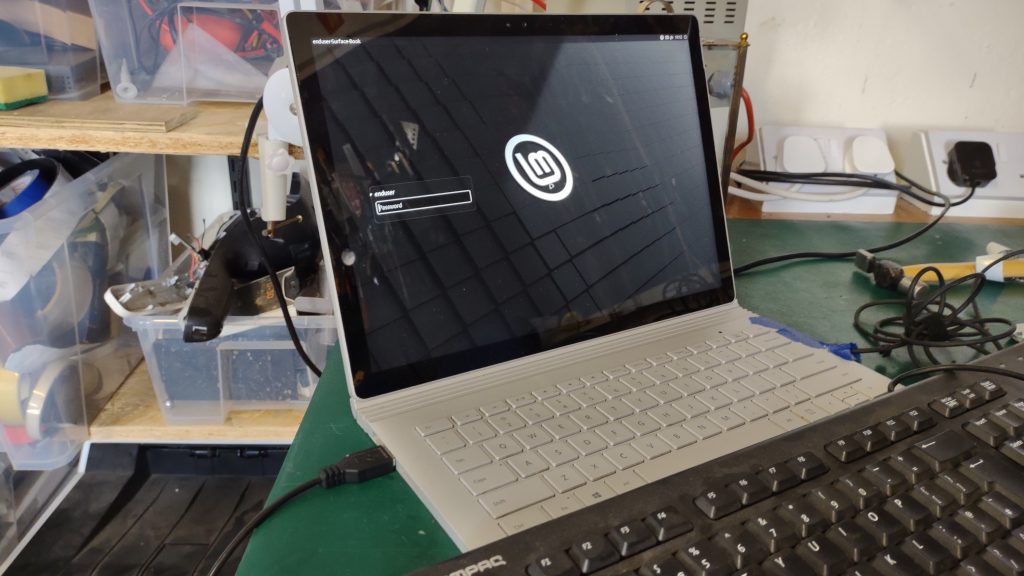
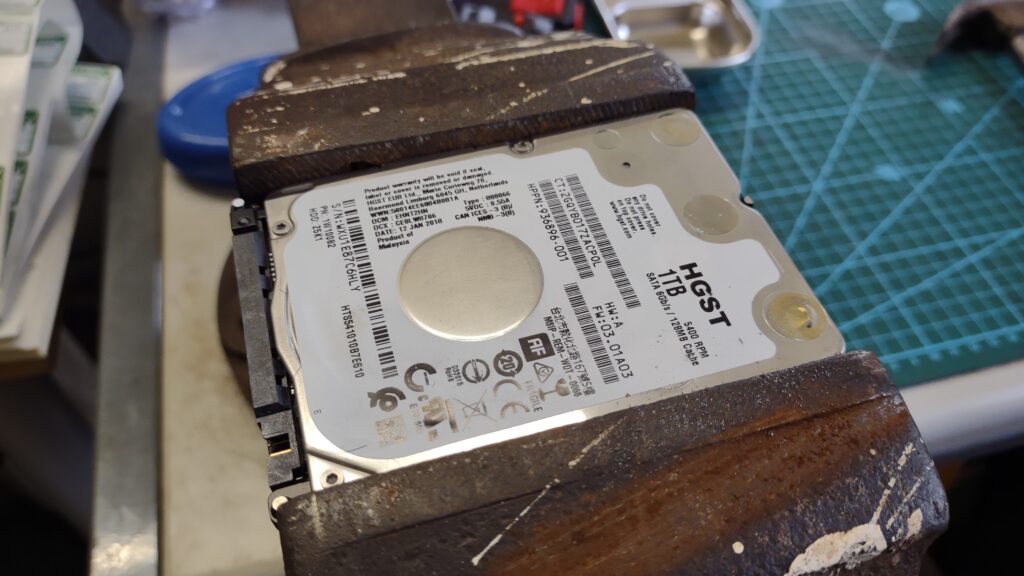
    Even though we aim to do our bit to save everyday items from the landfill, there are the odd occasions where we have to do a little destruction in our workshops! Today, we had a customer who needed an SSD upgrade for a laptop. They were concerned that their data might leak so asked us to destroy the old hard drive to prevent data from being read. We bound the hard drive to a clamp, and got started with physical destruction!

    Attempting data destruction

    So, Gareth grabbed a couple of nails, while I grabbed a hammer. Making sure I had a pair of safety goggles on beforehand (safety first, of course!), I tried my hand at hammering the nail through the metal casing. In both cases, the nail flew off out of my grasp. Hopefully nothing got damaged by the wayward nails!

    Next, we tried drilling through the metal casing. It turned out the casing was tougher than we thought, as the drill just wasn’t going through. I figured at this point that if we can’t go through the metal casing, then we can try drilling through the circuit board instead.

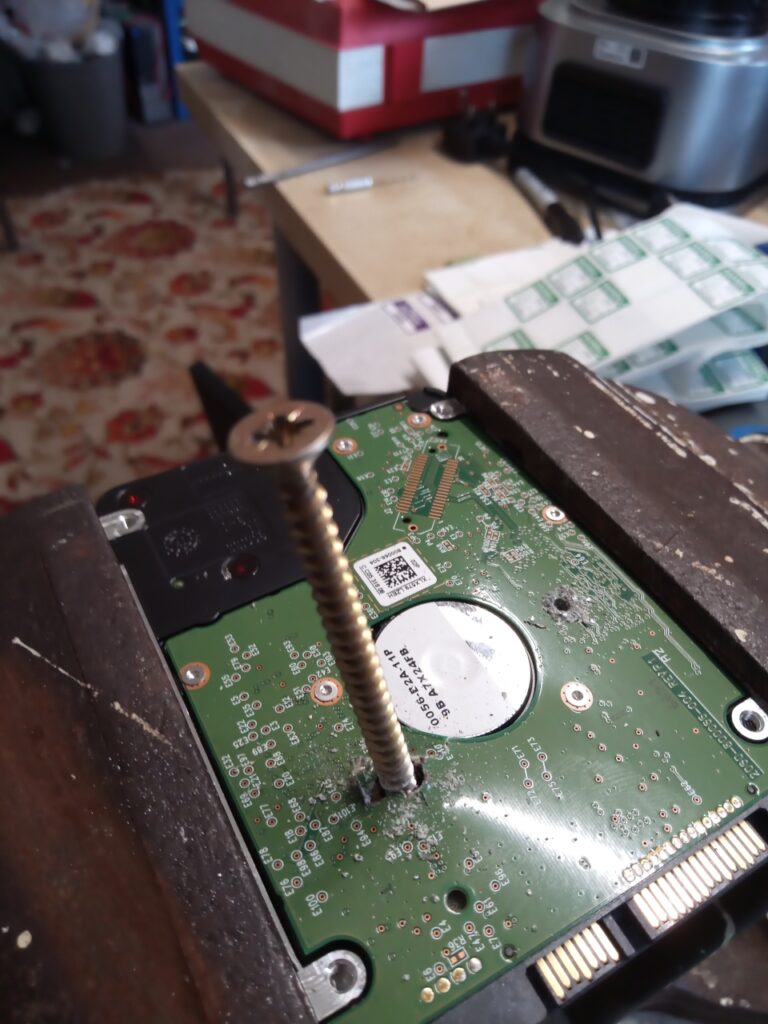
    I turned the hard drive circuit board side up on the clamp, and started drilling through the hard drive. After a few tries, I did manage to break the platter inside the hard drive. The job took a little while, but we managed to complete the job!

    Oh, and just to make sure that data recovery really is impossible, Gareth drove a large screw into the hard drive through the PCB with the electric drill. As you can see in the above photo, it was fairly comical seeing the hard drive impaled like this!