Ah, the humble computer. It’s certainly come a long way since the days of the first machines that comprise of vacuum tubes! We can do all kinds of everyday tasks with these that the vacuum tubes can’t do. Like playing video games, streaming videos and movies, access online services and connect with people across the world.
But gradually, all the additional performance gains over the years come at the cost of scope for upgrades. Various laptops especially, lost the option to upgrade the CPU, RAM and sometimes internal storage, without having to replace the whole motherboard, or even buy a whole new laptop or tablet. Unless you have a Framework laptop, of course!
However, we can still find ways to maximise the lifespan of the desktop PCs, laptops and, to an extent, tablets with Windows. So today, we cover a few ways to eke out every last working day of our computers.
Installing a GNU/Linux distro
You may have noticed tech news about Microsoft arbitrarily restricting computers eligible for upgrading to, or installing Windows 11 on, to those that meet certain specifications. Modern CPUs, a TPM 2.0 chip, among other things. And so, we might end up needlessly throwing away otherwise perfectly working computers because Microsoft decided they are too old for their latest shiny Windows operating system. But what if you can extend its service life by installing a GNU/Linux distro instead?
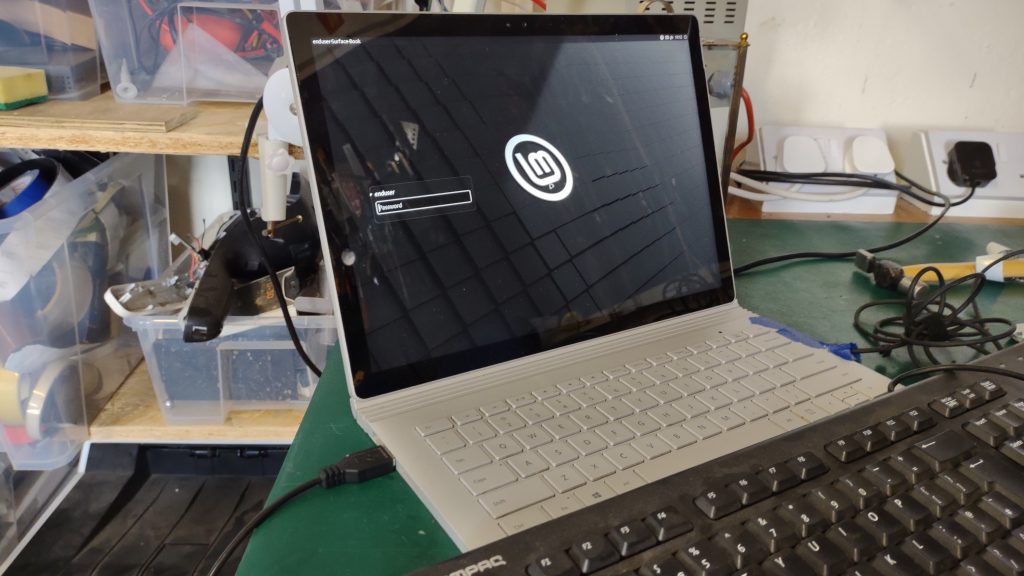
To give you an example, here is a Microsoft Surface Book, which we recently had in our workshops. We tried multiple times to upgrade the operating system on the computer to Windows 11, but it would abruptly shut itself down every time. So, I then tried installing Linux Mint (our recommended choice for people looking to migrate to GNU/Linux) from a USB stick I had at hand – and it installed and booted just fine! I did have to adjust the scaling settings, because at its native resolution everything looked super tiny on-screen!
And the beauty of GNU/Linux is that there’s a distro out there for virtually any computer. Whether it’s Fedora for most modern computers, Linux Mint with XFCE for older computers, or even Tiny Core Linux for vintage computers! In fact, several distros even run on Apple Macs with Intel CPUs!
Max out the RAM
Ongoing “RAMageddon” aside, adding more RAM to your computer can help improve responsiveness and allow for performing more intensive tasks. If, of course, it has the free slots or capacity to spare!
It’s a good idea to check the specs of your laptop, prebuilt desktop PC, or motherboard if you built your own desktop PC. This helps you check the maximum amount of RAM it can take, as well as whether you can actually upgrade the RAM in the first place. Otherwise, you’ll find you wasted a whole computer’s worth of hard-earned cash on a kit of RAM, only to find that your computer has only soldered-in RAM!
Upgrade the storage
Most modern computers feature solid-state drives (or SSDs for short), which have several advantages over hard disk drives. They have superior read and write performance.
However, many older computers still came with hard drives installed, which can make them feel sluggish. Therefore, they benefit from an upgrade to an SSD, whether it’s an NVMe drive, or even a SATA SSD.
Many desktop PCs usually have spare room for additional internal storage devices. This allows for a setup, where the fastest SSD (usually an NVMe SSD) contains the operating system, and the slower SSD or hard drive contains the user data, such as documents, music, videos and photos.
But if you can’t upgrade storage on your laptop or tablet because it has soldered-in storage, you can still expand the amount of storage it can access using an external hard drive or SSD, or a large capacity USB flash drive.
Wrapping up
Before spending hundreds in cash on a new desktop PC or laptop, it’s worth looking at your current computer to find ways to eke out another few years of life out of it. RAM and/or storage upgrades, and a lighter GNU/Linux operating system are some of the main ways you can upgrade your existing computer.
We hope you all have had a wonderful Christmas and New Year here at Reyt Repair. And what better way to kick off the New Year with something different from the usual repair talk? A space for which to say what’s on our minds – or to just spout out utter nonsense!
The idea here is to present a collection of shorter articles that cover different topics outside of the world of repairs. Today, I cover a few topics that come to my mind in recent months. So, here they are!
Loyalty in retail…to who, exactly?
A trend I spotted in recent years is that supermarkets and other retailers have started gating in-store offers and discounts for stuff you buy behind their loyalty programmes. Tesco has its Clubcard scheme; Sainsbury’s has the Nectar card; Morrison’s with its More card…well, these are just some examples.
But the thing is, it didn’t seem all that long ago that these supermarkets made special offers and discounts available to all of their customers in-store. We could go into the supermarket, buy what we need, and enjoy the savings without the need for a loyalty card or app. Now it’s a case of, “Oh, you don’t have our loyalty card or app? Well, too bad; you’ll have to pay full price for your groceries!”
Darning with faint praise
If you’re an avid gamer, then you’ll likely encounter short ditties and sequences that play upon game overs or failing challenges in video games. There are game overs where the protagonists meet their end in various ways. You have games that mock you for failing a particular challenge, such as the 1987 single “Oh Yeah” by Yello playing when you fail a licence test while playing Gran Turismo 4.
But then there’s games that sarcastically praise players who barely scrape through the difficult levels. For example, the 2008 video game Sonic Unleashed features two versions of the “results screen” that play when completing a level. There’s the regular version, which normally plays when you perform well enough during the level. But if you clear the level, but do it really badly (particularly on the Playstation 3 and Xbox 360 versions of the game), you get the dreaded “E Rank” version instead! The “E Rank” version is an intentionally bad rendition of the normal results screen music, with the orchestra deliberately playing the instruments off-key. I have some examples to share of when this sound would play in response to different real world events or situations;
A student barely scrapes through passing exams for a course at college or university
Any victories in military battles/conflicts that come at such huge cost to the victor(s) that they are tantamount to defeats, hence the term “pyrrhic victory”
It turns out a business barely broke even (or made a loss!) on revealing its end-of-year financial results
You manage to bake or cook food for a party, but the food turned out to taste disgusting to the point of making people who ate it physically sick!
The act representing your country finishes bottom in the Eurovision Song Contest. Bonus points worth of sucking rotten eggs if said act ends up with the dreaded “nil points”! *cough*Jemini*cough*
Metallic mayhem in the media
I remember watching the original series of Robot Wars on the telly as a youngster. It was huge in the nineties, when millions of people tuned in to watch the show! It’s where teams of amateur and professional roboteers build and operate remote controlled combat robots in an arena. Most events involve teams destroying opposing robots with weapons mounted on their own robots, though the first two series feature events that test their driving and control skills instead.
But there was something I thought was missing as a potential event, though; what if there was an event that features various different everyday objects that roboteers get to destroy in the arena? There could be old televisions, fax machines, toilets, grandfather clocks, and many other kinds of destructible stuff. For extra messiness, we could also add in foodstuffs such as watermelons, bananas, tinned foods and cakes. Imagine Sir Killalot spit-roasting a whole turkey over the fire pit amidst all the carnage!
Among the inevitable merch that comes with being a notable franchise, there was an official single (complete with its own music video), which was released as “Sir Killalot vs. Robo Babe – Robot Wars (Android Love)”; it uses the music from the TV show as the base for the song. I recently saw the music video on Bilibili (a Chinese language video hosting site, similar to YouTube, Dailymotion and others). If you want to see the video yourself, I recommend watching the video here instead.
From watching the video and finding as much info as I could about the track, the song is best as an instrumental if you can find it. I’d have to agree with the criticism about it, though; I didn’t see much Robot Wars about the song, with Sir Killalot (as in, the House Robot itself), the remote control roboteers use to pilot their robots, and a replica of the arena the female dancers perform on, the only obvious references to the show I noticed. And the song itself was pretty much a dud, as it peaked at a paltry #51 in the UK SIngles Chart – in the week “Can We Fix It?” by Bob the Builder spent its third week at the top of the charts!
The (Many (Mis)adventures of Lofi Girl
Speaking of YouTube, as someone who regularly follows the Lofi Girl YouTube channel after developing an interest in lofi music, I see polls where they ask the community a question, along with some canned answers. Personally, I find it much more humourous to come up with a different response, even if it’s only vaguely relevant to the question in some way. Let me show you an example;
The first thing that comes to my mind on seeing this poll, is a picture portraying a muster of storks constantly defecating out babies from the sky, with Jade (the mascot of the Lofi Girl YouTube channel) among the adults trying to catch the babies. Ensuring that there are boys and girls for every adult in the world – fears about overpopulation be damned!
One can really let their imagination run wild when responding to polls and other posts on the channel. Here are just a few other examples I have in mind;
Choosing between starting a study session at 1am or 1pm? How about starting a study session in 1 BC instead? Basically portray the study area as appropriate for the time era, with Jade in the role of the pregnant Virgin Mary.
The YouTube short, where a short animation of Jade visiting a cultural area of France is followed by various photos of different kinds of cheese? Imagine a cartoon, where she competes in the annual Cooper’s Hill Cheese Rolling and Wake events. She runs down the steep hill with fellow competitors, trips and tumbles down the hill (at one point landing arse-first on someone’s head on the way down!), and finally stops dazed and confused at the bottom of the hill!
If one wants to get rather edgy, how about this short where Jade accidentally pushes her cat out of her bedroom window? Surely one must admit that it could have been a lot worse: she could have pushed her cat out of the triplex penthouse window on floor 131, in Central Park Tower in New York, sending it plummeting all the way down the side the building, until it crash lands on top of a yellow taxi!
Asking folks what Jade would drink during her endless study sessions? Tea? Coffee? A mug of hot chocolate? Or maybe she would consume some energy drinks instead! A half-dozen of these in a short period of time, and the resultant caffeine overload would send her vigorously bouncing all over her bedroom, screaming “WhEeEeEeEeE!!!1!! bOuNcY bOuNcY bOuNcY!!!!1!!1!! wHeEeEeEeEeEeEeEeE!!!!!1!!1!1!!” No wonder she keeps failing all of her exams with all the resultant crashouts she has to endure if this is anything to go by…
When AI makes upgrades expensive…
I noticed lately that prices for RAM and internal storage have been going crazy; at various online retailers, RAM modules and kits are going for at least three four times what they were just a few months. Apparently, this was due to the three main manufacturers of RAM (Samsung, Micron and SK Hynix) shifting focus towards producing RAM for AI datacentres. Right now, it seems one can buy a whole laptop or a desktop PC for the cost of a single kit of RAM (depending on the amount of RAM the kit provides)!
The knock-on effect of this is that it will make computers, mobile devices and anything else more expensive while the manufacturers prioritise producing components for the AI datacentres that are popping up all over the place. Probably a good time to hang on to to computers and phones we have in the meantime!
The digital rivers of slop
Speaking of AI, you probably have noticed that in recent years, there’s a lot of content on many sites that are synthetically generated using AI tools. People are using such tools to generate video clips, images and photos, stories, essays, and other material, often with synthetic voiceovers. Because such material is often poor quality and clearly artificial, many people call such content “AI slop”.
Revenge videos are especially a common sight on YouTube (both as full videos and short-form versions); they are often created with largely similar thumbnails, story scripts, and various video footage used as backgrounds. They frequently also show words or sentences on screen as they are read out. A lot of channels that create such content post these videos multiple times a day.
What is particularly scary about AI, is that as the hardware and LLMs evolve, the content produced using AI tools are becoming more and more convincing. Before long (if not already), we’ll reach a point where AI-generated content is so convincing, even fact-checkers and those who are particularly savvy in spotting synthetic content would struggle to tell AI-generated material with authentic ones! I can forgive those who look at producers of AI-generated content the same way they look at hippos “muck-spreading” in the wild or in captivity!
Wrapping up
And these are what came to my mind in recent months! I find it refreshing to experiment with different kinds of articles and try out new ideas. In fact, I’d love to share more thoughts about what I’ve seen in the world in the future! Maybe I should get Gareth to share what’s on his mind in a future article, too…